OPERATIONAL LOGISTICS
Systems architecture for sustainment operations.
Focus: Automation, Predictive Modeling, and Asset Visibility.
Primary Architecture: C.U.L.T. Manager
The Problem Set
Disconnect between Demand (Loadout) and Supply (GCSS-A). Manual validation of TMRs leads to "Ghost Truck" scheduling—missions planned against non-mission capable assets.
The Solution
API integration between the Army's (Omni AI) Loadout and Palantir Vantage. The system queries what I describe as the "Golden Record" (fused GCSS-A/IPPS-A data) to validate feasibility before a mission is accepted.
Deep Dive: Data Ontology
The core achievement of CULT is not just the interface, but the underlying ontology. By linking disparate data objects—specifically the Equipment Status Report (ESR) from GCSS-Army and Personnel Records (Sanitized) from IPPS-A—I will create a live "Feasibility Index." This allows commanders to see not just if a truck is available, but if a qualified driver is present to operate it, removing the guesswork from movement planning.
Tactical Toolset (Power BI)
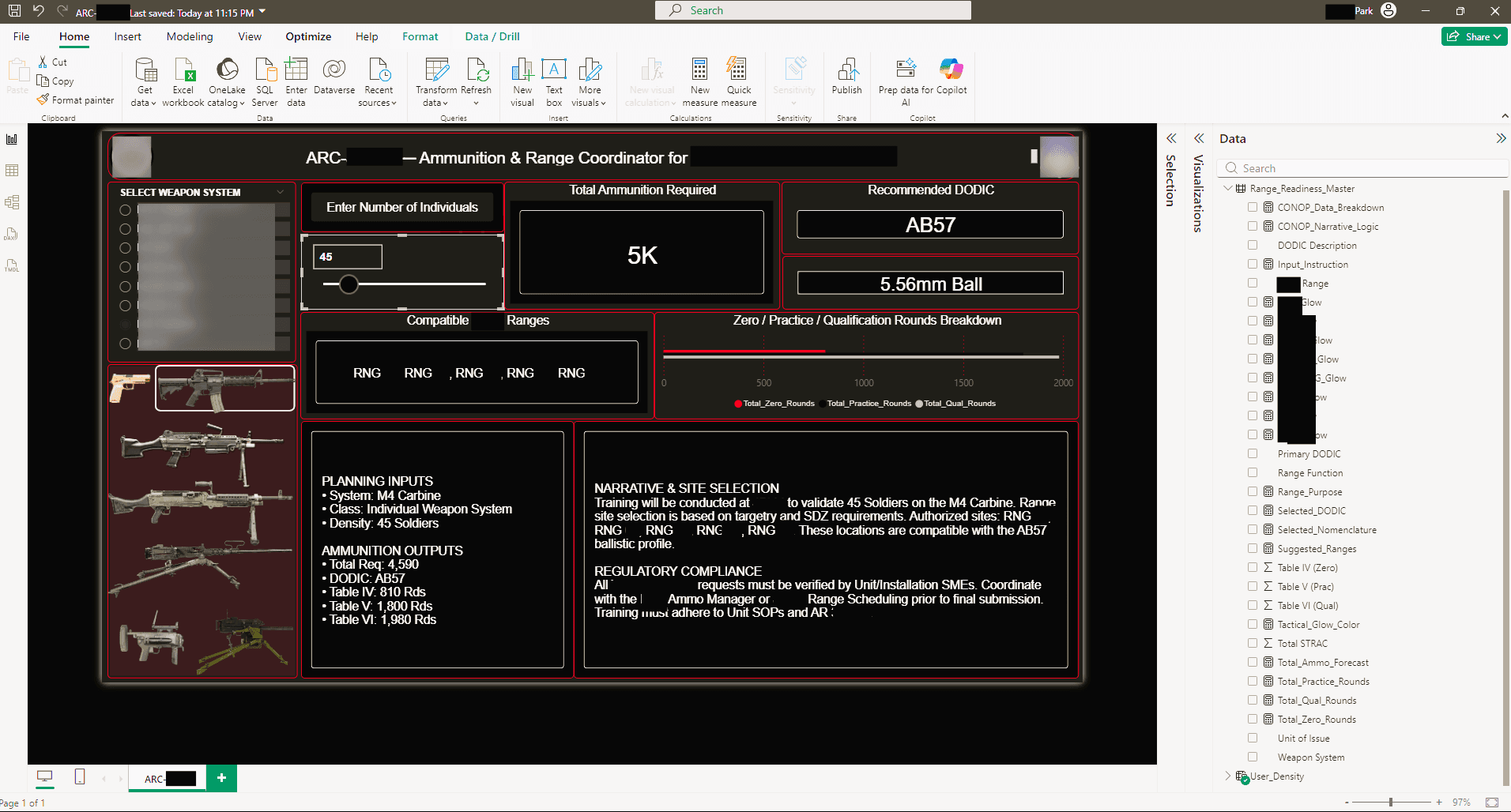
ARC: Ammunition & Range Coordinator
Automated the calculation of Class V requirements for weapon qualification ranges. Inputs: Density of soldiers and Weapon System (M4, M249, etc.). Outputs: Exact DODIC requirements, regulatory compliance checks, and range site selection validation.
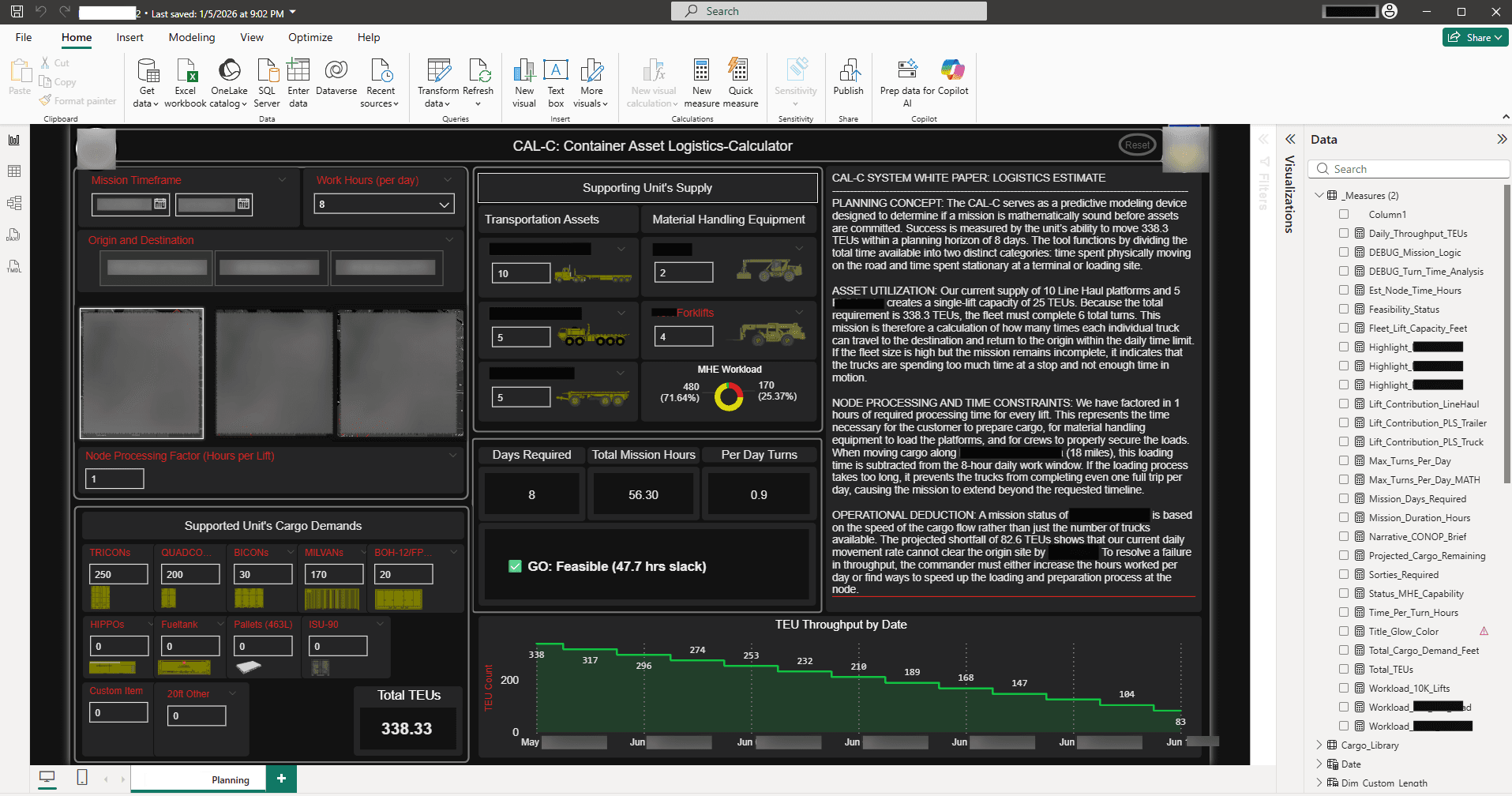
CAL-C: Container Asset Logistics Calculator
A predictive modeling engine for containerized movement. Showcased in Jan-26 Power BI for All competition @Department of War. Calculates "Slack Time" and feasibility based on Material Handling Equipment (MHE) throughput, node processing factors, and drive-time limitations. Provides a binary GO/NO-GO for mission planners.
MILITARY TIMELINE
Battalion Staff Officer (SPO/S3)
13TH CSSB // 2025 - PRESENTResponsible for Land & Ammunition operations. Architected the unit's transition to Palantir Vantage.
Platoon Leader / Executive Officer
VARIOUS UNITS // 2022 - 2025Direct leadership of logistics formations. Developed my first Power BI tools to solve immediate friction points in field environments.